Services
Accelerate Your Pipeline with Single-Cell Potency & Cytotoxicity Profiling Services
Find the Killers Your Bulk Assays Miss
Our technology provides in-depth, quantitative characterization of cytotoxicity, revealing functional differences and heterogeneity that may remain hidden in conventional assays. From assay design through data analysis, the solution is optimized for your research objectives, with no upfront investment in instrumentation required.
Functional Answers at Single-Cell Resolution
SINGLE-CELL SERIAL KILLING ANALYTICS & PHENOTYPIC PROFILING
- Best for: identifying highly potent “super-killer” subsets, understanding population heterogeneity, and linking cell-surface markers to direct cell-mediated killing.
- Deliverables: quantitative single-cell functional profiles, including killing kinetics, serial killing activity and correlation with phenotypic analysis. Time-lapse video analysis of single-immune cells encountering sequential targets; calculation of Cellply’s proprietary Unified Killing Score (UKS).
HIGH-THROUGHPUT E:T SCREENING WORKFLOWS
- Best for: preclinical optimization of CAR-T, CAR-NK, or TCR-T variants.
- Deliverables: target-cell killing kinetics and functional activity profiles across multiple products and experimental conditions.
CYTOKINE RELEASE
- Best for: correlating cytokine release with direct functional cell-mediated killing.
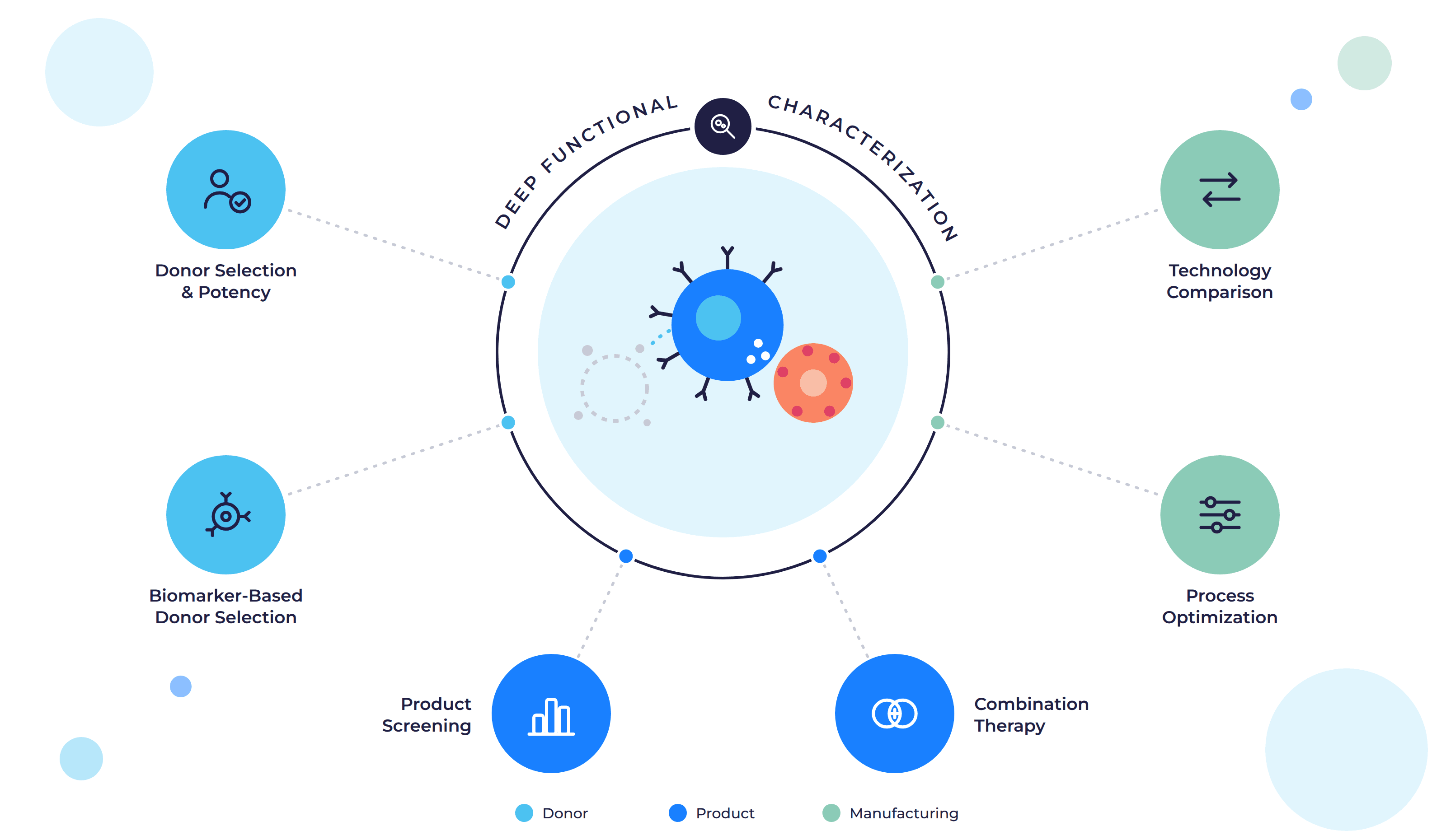
From Donor to Process, every Decision Backed by Function
- Donor Selection & Potency Screening: assess donor-derived product potency using functional killing assays to identify donors with the most desirable performance.
- Biomarker-Based Donor Selection: identify biomarkers associated with functional activity to characterize donor variability and support the selection of allogeneic cell products.
- Product Screening: compare different product designs targeting the same antigen, including alternative constructs, TCRs, or different tumor types expressing the same target, to assess differences in functional activity.
- Combination Therapy Screening: evaluate the functional activity of cell therapies in combination with other therapeutic approaches, including ADCC based strategies and combination treatments.
- Technology Comparison: compare different technologies, including instrumentation, transfection methods, and vector systems, and assess their impact on the functional activity of the resulting cell product.
- Process Optimization: characterize how manufacturing parameters affect product function, such as expansion time, culture conditions, or media composition, to support optimization of the production process.
- Deep Functional Characterization: combine multiple functional and phenotypic analyses to generate a deeper characterization of cell product behavior and link functional differences to specific cellular features.
From Your question to Your data
STEP 1 – Define the scientific scope
Our team meets with you to understand the scientific context, research question, and goals of your study. Together, we define how Cellply’s technology can support your project, align on the scope and objectives, and establish the next steps before experimental work begins.
STEP 2 – Experiment design
We work alongside your team to translate your scientific objectives into a tailored experimental design. Together, we define the appropriate cell model, experimental conditions, immunophenotyping panel, and functional readouts to capture the biological responses most relevant to your research question.
STEP 3 – OMW execution
The Cellply team manages the experimental preparation and materials required for your study. Before the main experiment, preliminary runs are performed to confirm sample quality and optimize the experimental conditions. Samples are loaded onto the VivaCyte platform for automated handling of cells and reagents, followed by time-lapse imaging for cell tracking, supported by AI-powered image analysis.
STEP 4 – Data analysis and reporting
Your results are delivered in comprehensive reports, including the relevant functional parameters and experimental findings. Raw data are also provided for further analysis and exploration.
Data You Can Trust, Batch After Batch
- SAMPLE ECONOMY: requires only a limited amount of cellular material, making it well suited for rare patient-derived samples and scarce product materials.
- ASSAY CONSISTENCY: platform validation yields a tight coefficient of variation (CV <20%), ensuring clinical-grade assay reproducibility across distinct batches
- DATA TRACEABILITY: all tracking metrics are backed by end-to-end audit logs generated by our AI image processing engine.
Need more information about our services?
Contract characterization services

Planning an upcoming study?

TN-007_Characterization of NK cell donors for allogeneic cell therapy using single cell serial killing
Learn how a single-cell serial killing assay allows deep characterization of immune cell function and enables ranking of donors for allogeneic NK cell therapy